
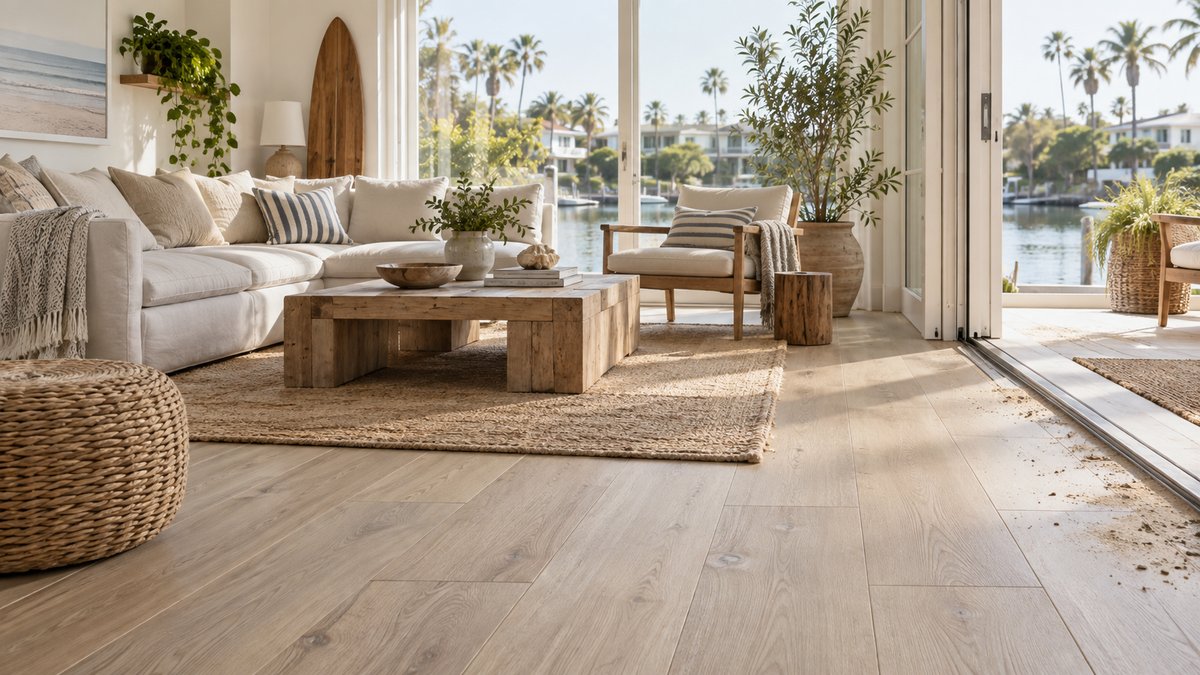
Quick answer: Flooring for a beach house in Venice has to survive sand, salty air, and marine-layer humidity most inland homes never face. Waterproof vinyl plank, tile, and treated engineered hardwood hold up best, each suited to a different room and exposure level. Matching the material to the room, not picking one floor for the whole house, is what keeps it looking right past the first rainy season.
What you should also be asking:
- Is luxury vinyl plank or hardwood the better choice for Los Angeles homes?
- What’s the difference between WPC and SPC luxury vinyl cores?
- Should you choose solid or engineered hardwood for an LA home?
- How does laminate flooring compare to luxury vinyl plank?
- Is an oil or urethane finish better for hardwood floors?
Table of Contents
- Why Venice Homes Need to Think About Flooring Differently
- The Real Threats to Your Floor Near the Beach
- The Best Flooring Options for a Beach House at a Glance
- Waterproof Luxury Vinyl Plank — The Practical Choice for Sand & Moisture
- Hardwood Near the Beach — When It Still Works
- Flooring for Canal-Front & Ground-Floor Homes in Venice
- Pet-Friendly, Sand-Friendly Flooring for Beach Life
- Flooring for Rentals & Vacation Homes vs. Full-Time Residences
- Getting It Right the First Time — What a Free Consultation With Barry Carpet Looks Like
- Vinyl Flooring for a Beach House — Sheet, Tile, or Plank?
- Laminate Flooring for a Beach House — Is It Worth the Risk Near Salt Air?
- Beach House Wood Flooring — Species and Finishes That Actually Hold Up
- Coastal Flooring Ideas by Room — Entry, Kitchen & Primary Suite
- What Flooring Costs Near the Beach in West LA
- Frequently Asked Questions
- Disclaimer
- Author & Content Transparency
Why Venice Homes Need to Think About Flooring Differently
Venice homes sit close enough to the Pacific that ordinary flooring advice doesn’t fully apply. Fine beach sand, salt-heavy air, and the marine layer’s daily humidity swing put more stress on floors here than in most of Los Angeles. Barry Carpet’s showroom sits right in Venice, at 140 Lincoln Blvd, close enough to see what that stress does to the wrong material choice.
Homes closer to the century-old Venice canals face an added layer of ambient moisture from the water itself. None of that means flooring has to be complicated. It means the choice has to fit the specific spot in the house, not a generic coastal checklist written for a different coastline.
The Real Threats to Your Floor Near the Beach
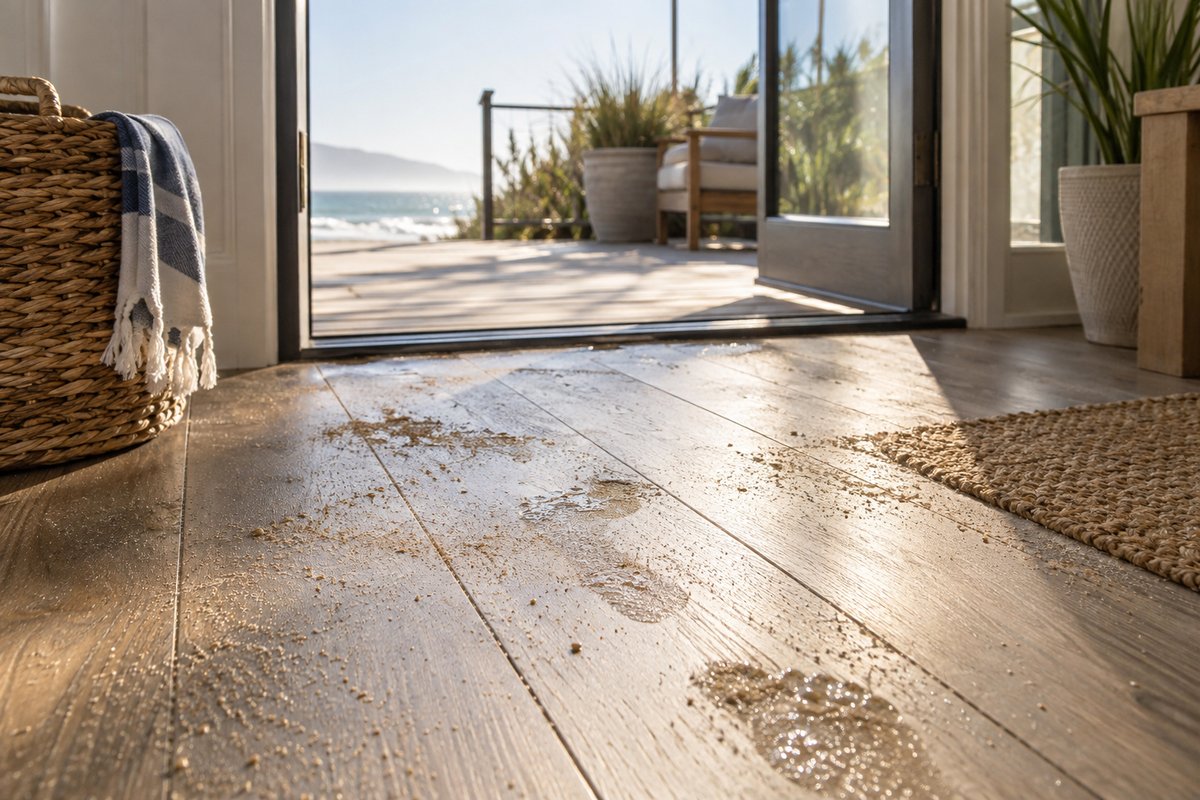
Three things damage flooring near the beach that inland homes rarely deal with. Sand acts like fine sandpaper under regular foot traffic, slowly dulling finishes. Salt-heavy air, sometimes called sea air, degrades finishes and corrodes metal transitions and hardware faster than it would a few miles inland. Marine-layer humidity makes wood expand and contract, which strains joints over time.
Large ocean-facing windows add a fourth factor. UV exposure fades flooring unevenly over the years, especially in a room that gets direct afternoon sun.
The Best Flooring Options for a Beach House at a Glance
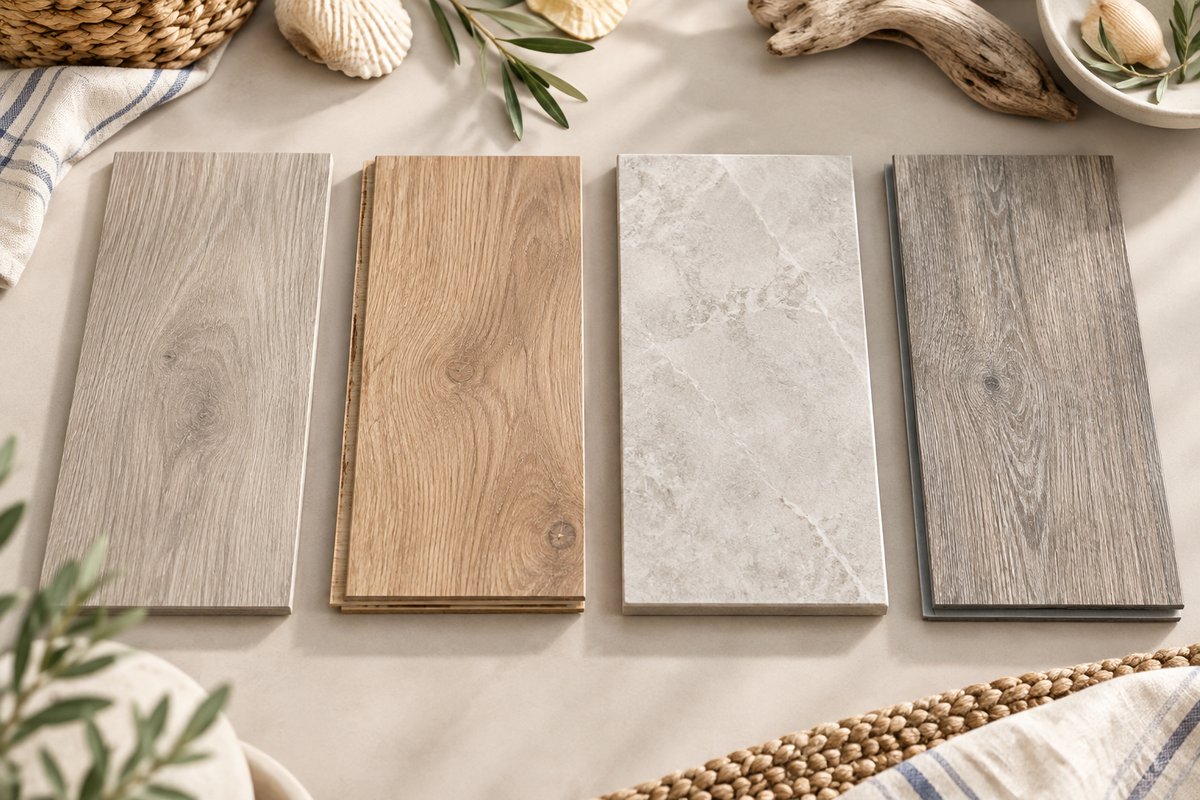
The four flooring types that come up most often for a Venice beach house are waterproof LVP, engineered hardwood, porcelain tile, and waterproof-core laminate. Each handles sand and moisture differently, and none of them is automatically wrong for every room.
| Material | Sand Resistance | Moisture Tolerance | Upkeep |
|---|---|---|---|
| Waterproof LVP | High | High (waterproof core) | Low |
| Engineered hardwood | Moderate | Moderate | Moderate to high |
| Porcelain tile | High | High | Low |
| Waterproof-core laminate | Moderate to high | Moderate to high | Low to moderate |
Waterproof LVP and porcelain tile handle sand and moisture with the least worry, which is why most of this guide leans on them for exposed areas. Engineered hardwood and laminate still work in the right spot, each with a condition attached, covered in the sections below.
Natural stone and polished concrete also hold up to moisture, though they’re less common choices here. Both cost more than LVP or tile, and concrete tends to feel colder and more industrial than most beach house interiors call for. Natural wood and natural stone sit at one end of that choice. LVP and laminate are synthetic materials, built specifically to resist what those natural materials struggle with near the beach.
Waterproof Luxury Vinyl Plank — The Practical Choice for Sand & Moisture
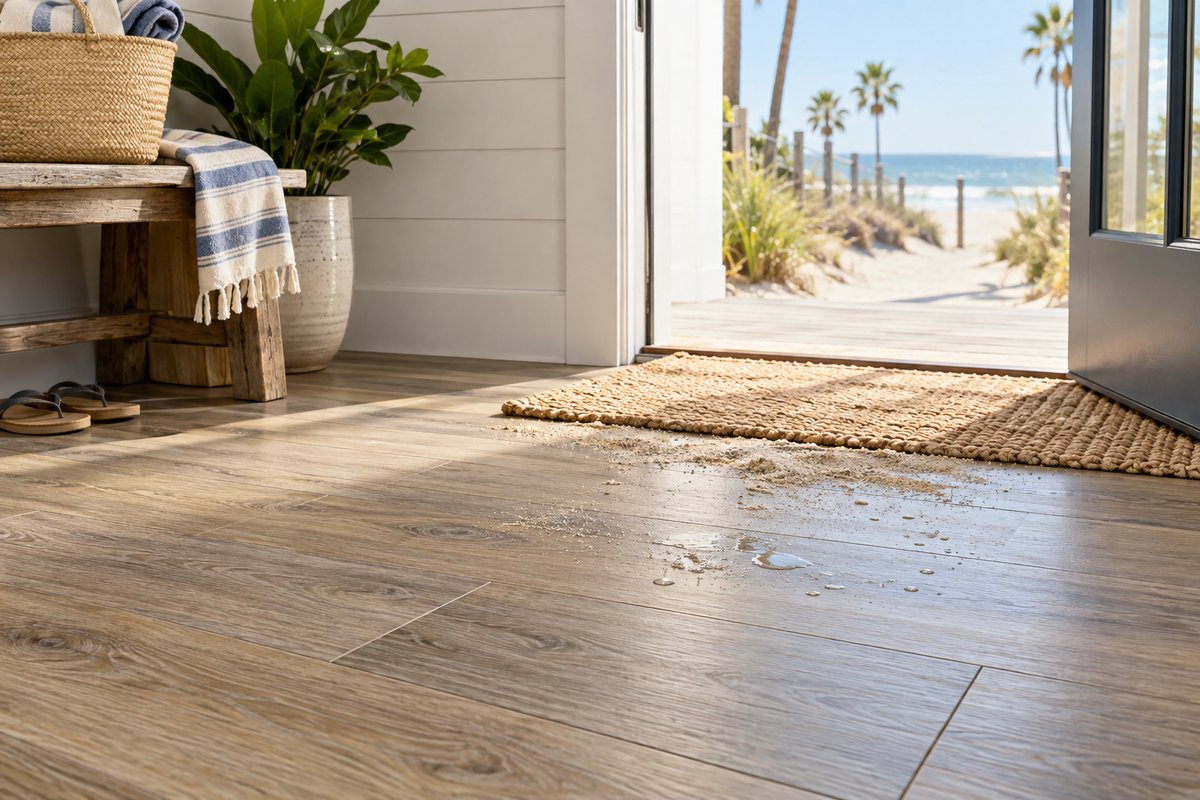
Waterproof luxury vinyl plank, also sold as luxury vinyl flooring or shortened to LVP, is usually the safest default for a Venice beach home. Its core layer blocks water entirely, so spills, wet feet, and rinsed-off sand can’t reach the subfloor. The wear layer, the tough top layer that takes daily foot traffic, resists the fine scratching loose sand causes over time.
Realistic wood-look finishes mean picking LVP doesn’t require giving up the look of a wood floor. That combination of waterproofing and a convincing finish is why it comes up first in most of these conversations.
Hardwood Near the Beach — When It Still Works
Solid hardwood floors are the riskiest common choice this close to the ocean, though it isn’t ruled out everywhere in a Venice home. Rooms with strong climate control and little direct exposure to sand or moisture, like an upstairs bedroom set back from beach-access doors, can still support it.
Engineered hardwood is a steadier middle ground. Its layered construction resists the expansion and contraction that solid wood goes through as humidity swings, which matters in a marine-layer climate. Neither option performs as well as waterproof LVP or tile in a mudroom or entry. Hardwood tends to work best set back from the parts of the house that see sand first.
Flooring for Canal-Front & Ground-Floor Homes in Venice
Homes directly on the Venice canals, sometimes called waterfront homes, deal with steady ambient humidity that inland Westside homes don’t. That alone is a reason to lean toward fully waterproof, floating-installation flooring rather than anything that depends on staying dry to perform.
Flood risk varies by exact parcel and isn’t the same for every canal-front address. Check a specific property’s flood zone status through the FEMA Flood Map Service Center or LA County’s flood zone determination tool before assuming a risk level either way. Whatever that lookup shows, a raised subfloor or moisture barrier is worth discussing with an installer for any ground-floor, canal-facing room.
Pet-Friendly, Sand-Friendly Flooring for Beach Life
Sand gets tracked inside constantly along Venice’s beach and boardwalk, whether or not a dog lives there. Dogs aren’t allowed on the sand itself under Los Angeles beach rules. Daily walks along Ocean Front Walk and trips to the fenced Venice-Westminster Dog Park still bring plenty of grit back into the house.
Waterproof LVP and tile stand up best in the high-traffic areas that see this kind of daily grit. Scratch-resistant wear layers handle nails and sand without dulling as fast as a softer finish would. A durable, fully sealed surface wipes clean instead of trapping salt residue in the seams, and regular cleaning is usually all it takes to maintain it. For a deeper look at flooring choices built around pets specifically, see Best Flooring Options for Pet Owners.
Flooring for Rentals & Vacation Homes vs. Full-Time Residences
A real, if modest, short-term-rental and vacation-home presence in Venice changes what counts as the right flooring for some owners. A property that turns over between renters every week or two needs different priorities than a house one family lives in full time.
For a rental, durability under frequent turnover and easy stain removal usually matter more than long-term underfoot comfort. For a full-time residence, comfort and resale value carry more weight, since the floor isn’t being reset for a new guest every week. Waterproof LVP tends to fit both cases well, while natural hardwood makes more sense in a full-time home with steadier care.
Getting It Right the First Time — What a Free Consultation With Barry Carpet Looks Like
A free in-home consultation is the fastest way to match a floor to a specific room, rather than guessing from a showroom sample under different lighting. It typically includes a look at the space, sample check-out to test colors and textures at home, and a written estimate before any commitment.
The team measuring and installing the floor is the same team on staff day to day, not a rotating group of subcontractors. That matters most in an older or unusually shaped Venice home, where subfloor prep and moisture management take more judgment than a standard install.
Get a Flooring Plan Built for Your Exact Spot in Venice
Every beach house has different exposure points, and a floor that works by the entry might be the wrong call in a bedroom. Barry Carpet’s free in-home consultation matches material to room before you buy anything.
- Employee installers, not subcontractors
- Free estimates and sample check-out to test colors at home
- Showroom in Venice at 140 Lincoln Blvd
For a more technical breakdown, continue below.
Vinyl Flooring for a Beach House — Sheet, Tile, or Plank?
Vinyl flooring near the beach comes in three formats, and each solves a different exposure problem. Sheet vinyl creates the fewest seams for water to find. Vinyl tile mimics stone in wet-prone rooms, and vinyl plank gives the most convincing wood look for main living spaces that see less direct moisture.
Sheet vinyl comes in large rolls, which means an entry or mudroom near a beach-access door can be covered with few or no seams. Fewer seams means fewer points where sand grit or standing water can work toward the subfloor. Sheet vinyl floor covering with backing is governed by ASTM F1303, a materials specification covering backing type and wear-layer construction (ASTM International). Meeting that standard doesn’t guarantee a waterproof result on its own. Installation quality at the seams matters as much as the material itself.
Vinyl tile suits bathrooms and entries where a stone-flooring look and pattern is wanted without stone’s cost or upkeep. Vinyl plank suits the rest of the home, where a wood look matters more than a stone one. Porcelain tile is worth specifying by name over standard ceramic tile in these same rooms. It’s denser and less porous, making it highly resistant to the moisture a bathroom or entry sees often. Solid vinyl tile intended for commercial, light-commercial, and residential use must meet a minimum wear-layer thickness under ASTM F1700 (ASTM International). A thicker wear layer generally resists the fine scratching sand causes better than a thinner one, though exact ratings vary by product line.
Rigid-core vinyl brands often market their products as fully waterproof, kidproof, and petproof. Those claims are worth confirming against the specific product line before buying, rather than assuming they apply to vinyl flooring in general.
Laminate Flooring for a Beach House — Is It Worth the Risk Near Salt Air?
Laminate flooring for a beach house works only when its core is genuinely waterproof, not just water-resistant. Standard laminate’s weak point is the seam between boards, where moisture gets in and causes swelling that can’t be reversed. A waterproof-core laminate closes that gap, but it still isn’t the first choice for a room that takes on standing water regularly.
Modern waterproof-core laminate uses a rigid core layer that resists swelling at the seam better than older laminate designs did. Even so, it fits better in rooms set back from direct beach access, sand, or standing water than in a mudroom or an entry that takes the brunt of it.
Beach House Wood Flooring — Species and Finishes That Actually Hold Up
Beach house wood flooring holds up better with the right finish than with the right species alone. Oil-finished hardwood resists salt-air moisture better than a standard polyurethane topcoat. Factory-applied aluminum-oxide finishes on engineered wood are the most resistant real-wood option, according to reporting on coastal home maintenance (OCNJ Daily).
Wood flooring stays most stable indoors between 30% and 55% relative humidity. The National Wood Flooring Association points to USDA Forest Service research on wood moisture content for damp coastal climates (National Wood Flooring Association). It recommends an average near 11%, in an 8% to 13% range. Wire-brushed or distressed surface textures also hide the fine scratches sand tends to leave better than a smooth, glossy finish does.
Coastal Flooring Ideas by Room — Entry, Kitchen & Primary Suite
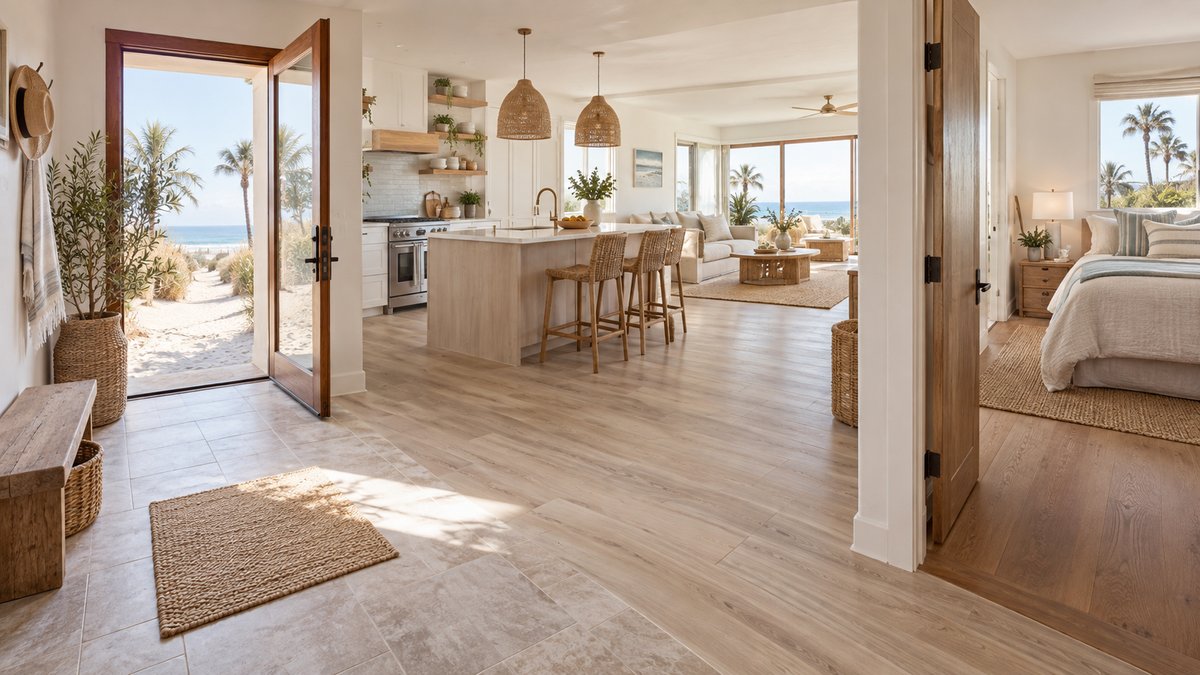
Coastal flooring ideas work best chosen room by room instead of picked once for the whole house. Coastal living means balancing sea air and sand with the relaxed decor most owners want. An entry that catches sand and salt spray needs a different floor than a primary suite that mostly sees bare feet.
A sand-trapping mat zone paired with fully waterproof flooring at the beach-access door catches most grit before it spreads through the house. Kitchens and bathrooms benefit from vinyl tile or waterproof LVP for spill resistance. Bedrooms set back from moisture exposure can carry a warmer wood-look LVP, engineered wood, or even carpet, as long as the room stays away from beach-access doors and bathrooms.
What Flooring Costs Near the Beach in West LA
Flooring costs near the beach in West LA vary by material, room size, and how much subfloor prep a moisture-exposed area needs. Waterproof LVP and laminate generally cost less installed than tile or hardwood, though exact pricing depends on the product line and the specific conditions inside an older Venice home.
Moisture-resistant underlayment adds a modest amount to the cost of new flooring. It reduces the odds of a callback or early replacement in a room with regular water exposure. Skipping it usually costs more later than doing it right the first time. Because so much depends on the specific property, a firm number only comes from an in-home estimate rather than a general online figure.
Frequently Asked Questions
What is the best flooring for a beach house?
For most Venice beach houses, waterproof LVP handles sand, salt air, and humidity with the least risk of the four main options. Porcelain tile is the toughest choice for entries and wet areas, though it feels harder and colder underfoot than vinyl. The right answer still depends on the specific room. A primary suite set back from beach access can support more hardwood than an entry that takes sand and salt spray every day.
What is the best flooring for a hot, humid climate?
In a humid, marine-layer climate like Venice’s, fully waterproof and dimensionally stable materials outperform anything that absorbs moisture. Waterproof LVP and porcelain tile hold their shape regardless of humidity swings. Solid hardwood and basic laminate can swell, gap, or warp as moisture rises and falls with the marine layer. Consistent indoor climate control matters more here than in most inland LA neighborhoods, since outdoor humidity swings more than it would a few miles from the coast.
How do I keep my floors from warping in a Venice beach house?
Choose a waterproof or moisture-resistant core for any room near sand, beach traffic, or canal-side humidity, since that removes the main cause of warping before it starts. Keep indoor climate control consistent instead of letting the house swing with outdoor humidity. For a ground-floor or canal-front room, ask an installer to check subfloor moisture levels before installation rather than after a problem shows up.
What is the Rule of 3 for flooring?
The Rule of 3 is a design guideline that limits a home to three flooring types, tones, or textures so the space feels intentional instead of scattered (House Digest). In a beach house, that might mean waterproof tile at the entry, LVP through the main living space, and a warmer wood-look material in bedrooms. Sticking to three keeps transitions between rooms feeling planned rather than random.
What flooring is on trend in 2026?
Wide-plank hardwood, typically 7 to 10 inches wide, and white oak tones remain the strongest trends heading into 2026. That’s according to industry trade coverage citing the National Wood Flooring Association (Wood Floor Business). Warm neutrals and textured finishes are also popular, following a decade dominated by luxury vinyl. None of that changes the material decision for a beach-adjacent room in Venice. Trend or not, a room’s exposure to sand and moisture still comes first.
How do I make my house look beachy?
A beachy appearance usually comes from light, warm-toned flooring, natural textures, and materials built for coastal environments rather than formal interiors. Wide-plank wood-look LVP in a driftwood or whitewashed tone reads more seaside cottage than sleek modern, without the upkeep real reclaimed wood requires. A woven, jute or sisal-look area rug over the main flooring rounds out the look in a living room or bedroom.
What is the best flooring for a summer house?
For a part-time summer house, low-maintenance flooring that tolerates being closed up for stretches of time matters as much as looks. Waterproof LVP handles humidity swings while the house sits empty better than solid hardwood, which needs more consistent climate control to stay stable. Tile is another solid option, since it isn’t affected by humidity at all when the house is unoccupied for weeks at a time.
Is vinyl or laminate flooring better for a beach house?
Vinyl generally handles beach conditions better than laminate, mainly because a fully waterproof vinyl core doesn’t depend on sealed seams the way even a waterproof-core laminate does. Laminate can still work in rooms set back from direct sand and moisture exposure, where its lower cost is a real advantage. Vinyl plank, vinyl tile, and sheet vinyl each fit a different room. The more useful question is usually which vinyl format fits a specific space, not vinyl versus laminate as a whole.
What are the best coastal flooring ideas for a small beach house?
In a small beach house, sticking to one or two flooring materials throughout, rather than a different one in every room, keeps the space feeling larger and more cohesive. Waterproof LVP in a light, warm tone works through most of a small home, with tile reserved for a bathroom or entry that takes on more moisture. Fewer transitions between materials also means fewer seams where sand and water can collect.
What does beach house flooring cost, and does canal-front or ground-floor construction change the price?
Cost depends more on room-specific conditions, room size, and subfloor prep than on a general per-square-foot number that applies everywhere. A canal-front or ground-floor room often needs extra moisture-resistant underlayment or subfloor work, which adds cost but reduces the risk of an early replacement. Because so much depends on the specific property, a firm number only comes from an in-home estimate rather than a general online figure.
See Barry Carpet’s Beach-Ready Flooring in Person
Photos only show so much. Come see how these materials actually look under Venice’s light before you commit to one.
- Woman-owned flooring business based in Venice, CA
- Guaranteed installations
- Financing options available
Disclaimer
This information is provided for general guidance when choosing, installing, and maintaining flooring in a Venice, CA beach or canal-front home. Flooring performance can vary based on material, installation quality, subfloor condition, sun and moisture exposure, and how close a room sits to sand, salt air, or the canals. Product specifications, waterproof-core ratings, pricing, and material availability may also change over time. Before deciding, verify current specifications for the product line you’re considering, and check your own property’s flood zone status through the FEMA Flood Map Service Center or LA County’s flood zone tool rather than assuming a risk level. For property-specific recommendations, contact Barry Carpet before purchasing.
Author & Content Transparency
This guide was created by the Barry Carpet team, a flooring retailer and installer based at 140 Lincoln Blvd in Venice, CA, serving the Westside of Los Angeles. The recommendations reflect what our team sees firsthand in Venice-area homes: how sand, salt air, and marine-layer humidity affect waterproof LVP, engineered hardwood, laminate, tile, and carpet, and how canal-front and ground-floor properties add their own moisture considerations.
This article combines that hands-on experience with research from manufacturer specifications, industry standards bodies (ASTM, the National Wood Flooring Association), and public sources on local conditions. AI-assisted tools helped with keyword research, drafting, and fact-checking; a member of the Barry Carpet team reviewed and approved the final content, and added the images, before publishing.
The goal is to help Venice-area homeowners narrow their flooring choice by room and exposure level before an in-home consultation, not to replace one.